
Seven AI app builders compared on what you keep
If you are choosing an AI app builder, the question is some version of “how is this different from Lovable?” Until recently, our own answer was that most builders stop at a preview, and that making the app real means exporting the code and finding hosting yourself.
That answer is out of date. We read the documentation and pricing pages of the seven builders people compare us with most: Lovable, Bolt.new, Replit, v0, Emergent, Base44 and Bubble. Every one of them now hosts what it builds. So the real question is a different one: once your app is live, what do you keep, and what do you control?
We put the answer in a comparison table. This post explains how we made it and what is behind the rows.
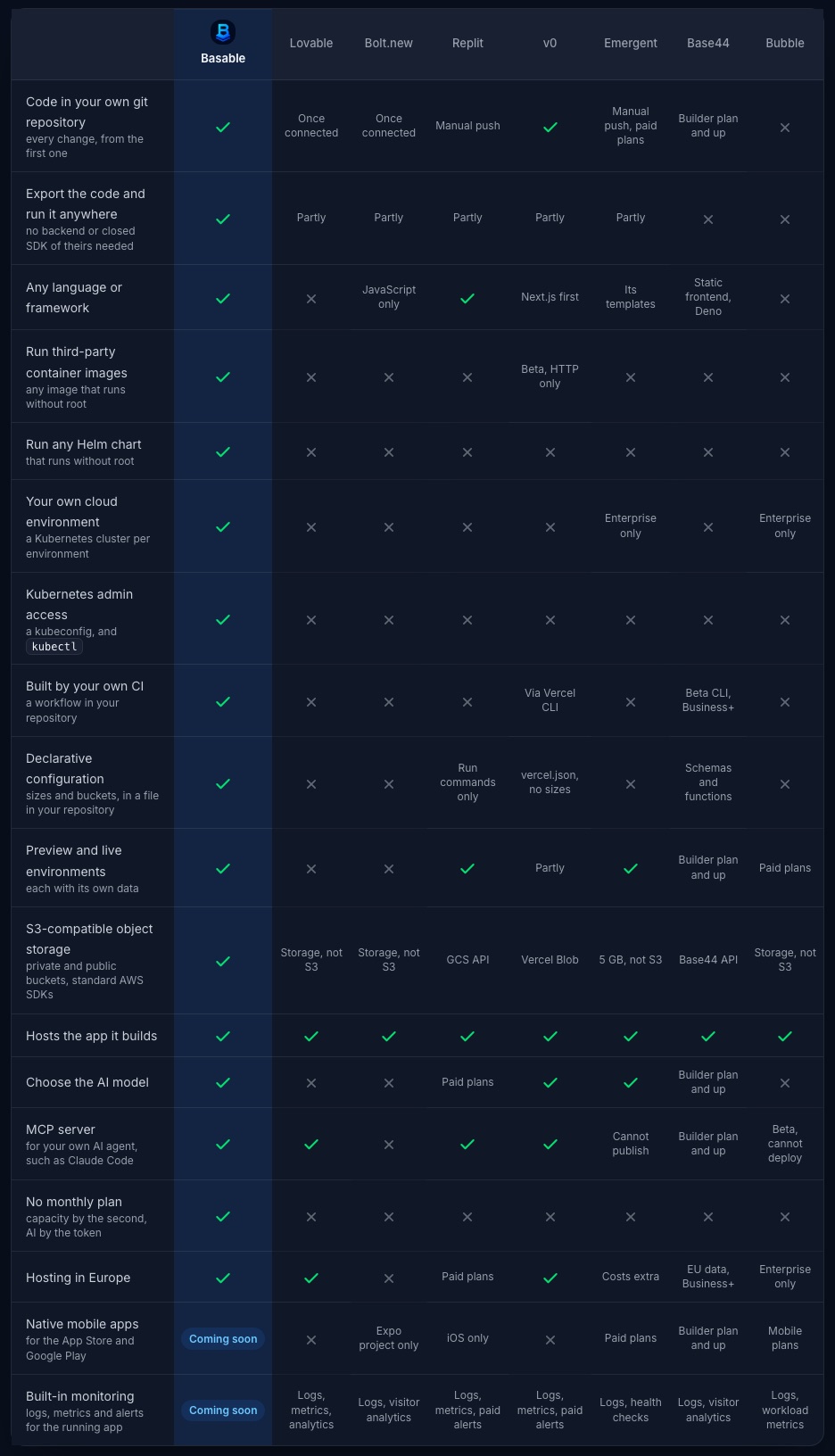
How we compared
Three rules, so the table is something you can check rather than something you have to believe:
- Every claim about another product comes from that product’s own documentation or pricing page, read on 11 October 2026.
- When a product’s documentation says nothing about a feature, we mark it as not offered.
- When a feature depends on a plan or comes with a catch, the cell says so in words, such as “Builder plan and up” or “Beta, HTTP only”, instead of a tick.
These products change every month. If a cell is out of date, write to legal@basable.com and we will correct it.
Your code
Lovable, Bolt.new and v0 send the code to GitHub automatically once you connect it, and that deserves credit. On Replit and Emergent the code reaches GitHub when you push it, on Emergent only on a paid plan, and Base44’s two-way sync starts at its Builder plan. Bubble builds visual apps, not code. In its own words, “Bubble apps can only be run on the Bubble platform”.
Having the code is half of it. The other half is whether it runs without the vendor. A Base44 app calls Base44’s SDK, and its documentation says the hosting, the sign-in and the database cannot be exported. Lovable documents moving a backend only to Supabase, hosted or self-hosted. Replit Auth signs your users in with Replit accounts, and Emergent’s login runs on Emergent’s own domain, with branding you cannot remove.
A Basable project is ordinary code in your own repository, committed from the first change: container images built with Dockerfiles or Bazel, a CI workflow and Kubernetes manifests. There is no backend of ours behind it and nothing closed in it (the Rust frameworks a plan mode project uses are open source, on crates.io), so any Kubernetes cluster can run it.
Your stack
Replit comes closest here: its Agent works in Python, Go, Rust, Java and more. Bolt.new supports JavaScript backends only, v0 works best with Next.js, Emergent builds from its templates, Base44 builds React with Deno functions, and Lovable offers no choice of framework at all.
Basable runs anything that fits in a container and speaks HTTP. That includes software you did not write: a published container image, or a Helm chart, as long as it runs without root. Of the seven, only Vercel, where v0 deploys, documents running a container of your own, and only as an HTTP function, in a beta that started in June 2026. None of them installs a Helm chart.
Your own cloud environment
This is the row we care most about. On Basable, the preview and the live
environment each get a Kubernetes cluster of their own, with their own data,
resource limits and network rules, sandboxed from every other project at the
kernel level. You can download either environment’s kubeconfig and use
kubectl on it, as you would on a cluster you run yourself.
None of the seven gives you a cluster. Replit runs apps in managed containers, v0 runs them as Vercel functions, and the others run them on platforms you do not see into. Emergent and Bubble offer an environment of your own on their Enterprise plans: Emergent deploys into your own cloud, and Bubble’s dedicated instance gets isolated compute.
Your build
By default, all seven build the app on their own infrastructure. Two document
a build in your own CI as well: Vercel, where v0 deploys, through its command-line
tool, and Base44, through a command-line tool in beta with an API key from its
Business plan up. On Basable, the build is a
workflow in your repository, run by your own CI. It builds the container images
and renders the manifests the platform deploys, and you can read, change and
rerun every step of it. What each environment gets, its CPU, memory, storage and
buckets, is declared beside the code in .basable/config.yaml, so a change to
the infrastructure is a commit like any other.
How you pay
All seven sell monthly plans with credits, messages or tokens, and most of them charge for hosting beyond what the plan includes. Basable has no monthly plan: after a month free per environment, you pay for the capacity you reserve, by the second, and for AI by the token. The pricing page has every rate.
Where others are at least on par
A comparison that only lists our wins would not be worth much, so here is where the others do as well or better.
- More models. Basable runs Anthropic’s Claude models. Replit, Base44 and v0 offer models from several providers, and v0 has its own besides.
- Native mobile apps. Bubble, Base44, Emergent, Bolt.new and Replit build apps for the app stores, to different degrees: Replit for iOS only, Bolt.new as an Expo project you build and submit yourself. Native apps are coming to Basable; today it builds web apps and APIs.
- Built-in monitoring. Replit and Vercel, where v0 deploys, chart requests,
errors and resources for the running app, and the others show at least its
logs. Built-in monitoring is coming to Basable too; today you read your app’s
logs with
kubectlon its own cluster. - Maturity. Basable is in alpha. The pipeline from description to deployment works end to end, but expect rough edges.
Lovable, Replit and v0 also let your own AI agent work on a project over MCP, which Basable does too, and Lovable, v0 and Replit’s paid plans can host in Europe, where Basable’s servers are.
Why this matters
On day one, every builder on the list gets you an app. The differences show up later: when you need a language the builder does not support, a piece of software that only ships as a container image, a look inside the environment your app runs in, or a way to leave. That is why Basable starts from code you own and an environment you control, instead of adding them later.
The full table is here. To try Basable, sign up with just your email: every new organisation gets a month free per environment.